

The U.S. Census Bureau released new data at the end of October showing that Texas had the nation’s highest rate of children and adults without health insurance in 2025. The data reinforce that Texas leaders should make health coverage a top priority in the 2027 legislative session.
Why Health Insurance Matters
Health insurance makes it easier for kids and adults to see a doctor — helping Texans catch cancer before it spreads, giving pregnant women a chance to start prenatal care earlier, ensuring more kids get vaccines, and letting sick children get healthy and back to school faster. For example, a 2024 national survey shows that 96% of kids with Medicaid or other public health insurance saw a doctor in the previous 12 months, compared with just 77% of kids without health insurance. Children insured with Medicaid or CHIP are also more likely to get dental exams and eye exams than children without insurance. Uninsured individuals typically must wait longer to seek medical care, leading to worse health outcomes and higher costs for families and taxpayers.
While Texas has a network of resources for uninsured families, like community health centers, these clinics usually provide only preventive and basic primary care. More specialized services such as cancer treatment, children’s eyeglasses, chronic disease management, and specialty care are generally only accessible to those with insurance. Even basic care can be limited, as charity clinics often struggle to meet demand and are unavailable in many counties, particularly in rural areas.
Unpacking the Texas Uninsured Data
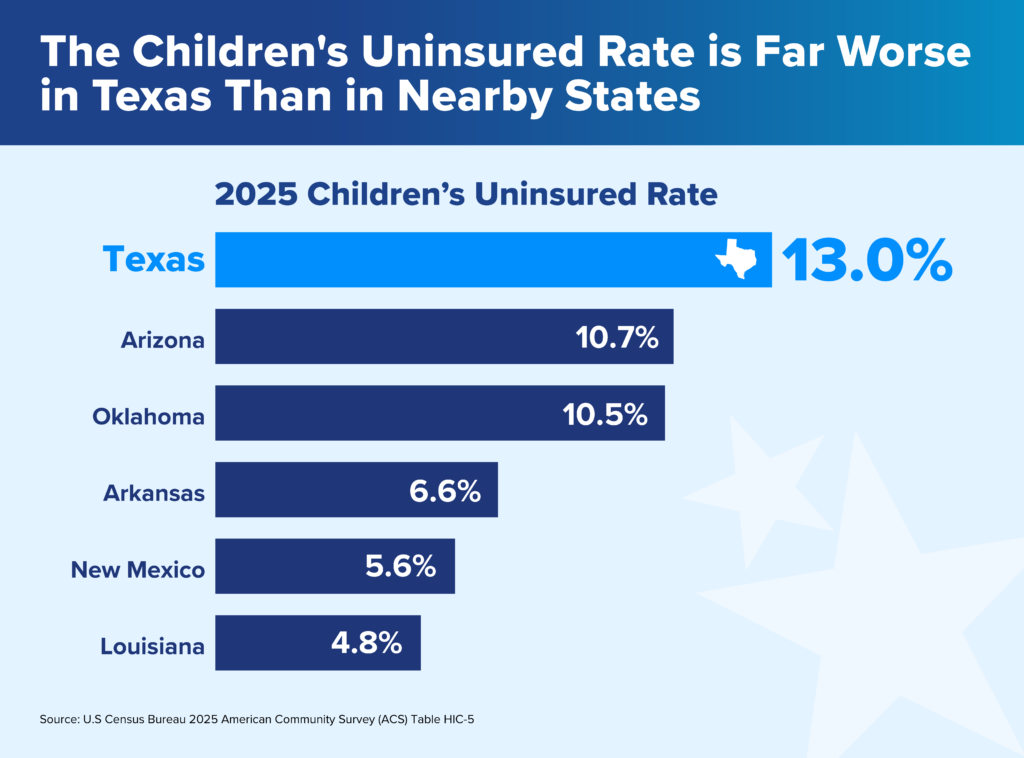
The new Census Bureau data show the state’s overall uninsured rate in 2025 was 16.5%, nearly double the national rate of 8.4%. Looking at specific age ranges, we see that 21.8% of Texas adults age 19–64 and 13.0% of Texas children did not have health coverage in 2025.
What does that mean in raw numbers? The Census report says Texas had 5,163,000 uninsured residents in 2025, eclipsing every other state. About one million Texas kids did not have health coverage last year.
According to the Census data for 2025, the Texas uninsured rate for all ages (16.5%) was much worse than the rates in nearby states, including New Mexico (10.5%), Arizona (11.8%), Oklahoma (12.6%), Louisiana (8.1%), and Arkansas (9.1%).
The same trend holds for children’s uninsured rates, with states in this region performing much better than Texas.
Analysts expect the state’s uninsured rate to rise in 2026 since Congress did not renew the enhanced advanced premium tax credits (EAPTCs) that millions of Americans relied on for affordable insurance through HealthCare.gov.
What Policymakers Can Do to Reduce the Uninsured Rate
To help connect children with health coverage, policymakers should focus on making sure kids who are currently eligible for insurance are able to sign up and stay enrolled. In fact, previous research suggests that around half of Texas kids without health coverage are actually eligible for insurance through Medicaid or CHIP. Texans trying to sign up for Medicaid currently face long delays as they wait for state eligibility workers to process their applications. State leaders should improve the sign up and renewal process for eligible Texans and invest in better outreach to families.
State and federal leaders can also provide additional paths to health insurance for Texans who have no affordable options. For example, Texas leaders could finally implement Medicaid expansion, which would allow low-income adults to enroll in the insurance program. Under current Texas law, the primary adults eligible for Medicaid are low-income seniors, pregnant and postpartum women, and Texans with disabilities. Meanwhile, Congress could reinstate the enhanced premium tax credits for HealthCare.Gov insurance, which expired at the end of 2015, and take other steps to give Texans more insurance options.
Texans Care for Children gratefully acknowledges Methodist Healthcare Ministries of South Texas, Inc., for their financial support of this publication. The opinions expressed in this document are those of Texans Care for Children and do not necessarily reflect the views of Methodist Healthcare Ministries.