

We are thrilled to share an update on HB 713 — an important and widely supported bill passed in 2025 to help Texas strengthen its response to the maternal health crisis by removing delays in reporting so Texans can get more timely and actionable maternal mortality data. Lawmakers took meaningful action, and the Department of State Health Services (DSHS) is now moving quickly to implement this new law.
Texas continues to have a high rate of maternal morbidity and mortality, with persistent and preventable disparities that fall most heavily on Black women, and women in rural and low-income communities. The Texas Maternal Mortality and Morbidity Review Committee (MMRC) has repeatedly found that the majority of pregnancy-related deaths are preventable, driven by delayed access to care, untreated chronic conditions, mental health needs, substance use disorders, and gaps in continuity of care after delivery. Many Texans must travel long distances to get basic prenatal or postpartum services. Nearly half of maternal deaths occur after childbirth — often months into the postpartum period, when coverage, follow-up care, and coordinated support are most fragile.
Why This Bill Was Such a Critical Fix
For years, the Maternal Mortality and Morbidity Review Committee faced major delays reviewing maternal deaths because nurses were not allowed to see unredacted medical records. Under the old process, DSHS had to remove every provider and facility name before a nurse could even begin a case review.
This step — shown as Step 3 in the agency’s workflow graphic — took an average of 45 hours and sometimes up to 250 hours per case, creating long backlogs that slowed down recommendations the state relies on to improve maternal care.
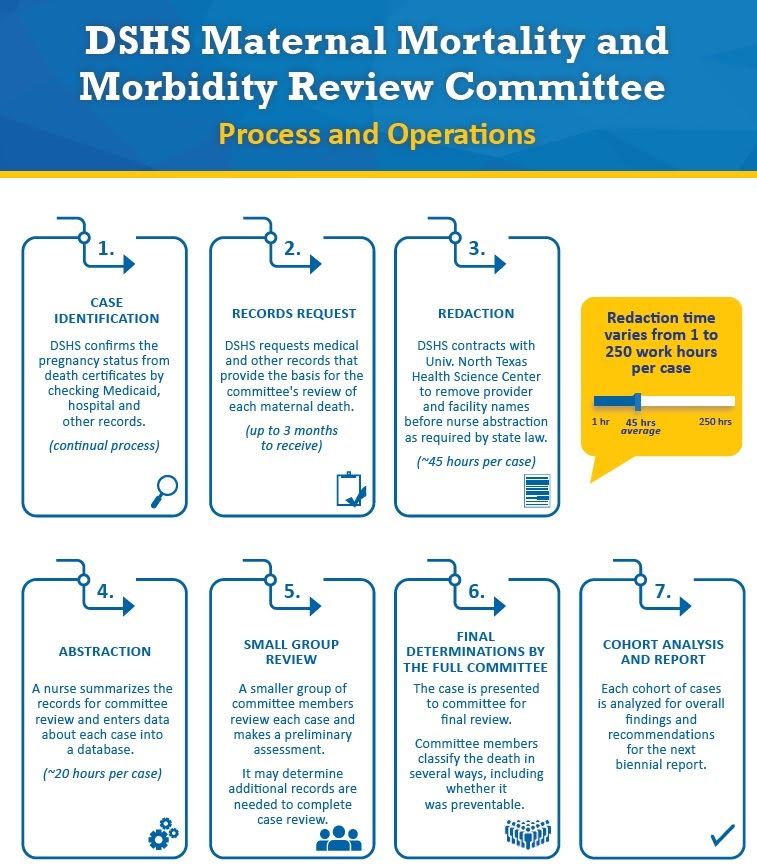
HB 713 Solves that Problem
The bill created a narrow, thoughtful exception that allows trained DSHS nurse abstractors to review unredacted records while maintaining all required confidentiality protections.
By removing Step 3, lawmakers helped eliminate the bottleneck of the process — making reviews faster, more efficient, and more cost-effective.
A Smoother, Faster Process Going Forward
Thanks to this legislative fix, nurses can now review unredacted records and build accurate case narratives without delay. Redaction still occurs — but after abstraction, and only for the materials that go to MMMRC members. The state remains fully compliant with privacy laws while moving cases through the system much more efficiently. This updated workflow is a smart, practical improvement that supports timely maternal health recommendations.
DSHS Is Moving Quickly To Implement This Important Legislation
We’re pleased to see that DSHS is implementing HB 713 efficiently and with great attention to detail. The agency is finalizing its updated redacting contract with the University of North Texas Health Science Center, with execution expected in late December 2025.
What This Means for Timeliness
While DSHS isn’t yet ready to quantify exactly how much faster cases will move, eliminating a step that previously consumed up to 250 hours per case will have a major impact on how current the data can be. Texas will still release maternal mortality reports on the same biennial schedule, but historically those reports have included data that was three or even four years old. With this change, future reports will finally be able to incorporate cases from just one or two years prior — giving lawmakers a far more accurate and relevant picture of what is happening now.
This improved timeliness matters. More current data means state leaders can identify emerging maternal health challenges earlier, respond more effectively, and ensure women receive the care they need during pregnancy and throughout the year after birth.
We deeply appreciate Rep. Donna Howard’s leadership and the Legislature’s commitment to getting this across the finish line.