

Over the last year, 40,000 pregnant Texas women waited more than a month for the state to process their applications for Medicaid health insurance — delaying their access to prenatal care.
Prenatal care is one of the most important tools we have to support healthy pregnancies, healthy moms, and healthy babies. Early visits help identify health risks, manage chronic conditions, and ensure that both mother and baby are on a healthy path from the very beginning. Prenatal care is a key strategy for reducing infant mortality — an issue that the Texas House Committee on Public Health will be studying this year in preparation for the next legislative session.
Prenatal care is also something policymakers across the political spectrum agree on: when women can access care early in pregnancy, outcomes improve.
But in Texas — and across the country — too many women are not getting prenatal care as early as recommended.
A Growing Delay in Prenatal Care
Recent national data show a troubling shift. After several years of improvement, the share of women receiving early prenatal care has begun to decline. Between 2021 and 2024, prenatal care in the first trimester dropped from 78.3% to 75.5%, while care beginning later in pregnancy increased.
At the same time, many women are going without care until the third trimester — or not receiving care at all.
Texas reflects — and in some cases fares worse than — these national trends. For example, in 2024, 11.3% of mothers in Texas began prenatal care in the third trimester, or not at all, compared to 7.3% of women nationwide.
Delays in care are not experienced equally. In Texas, some mothers are significantly more likely to receive late or no prenatal care compared to others. Barriers such as lack of insurance, limited provider availability, and geographic gaps in care — particularly in rural areas — continue to drive these disparities.
These delays matter. When prenatal care begins later in pregnancy, there are fewer opportunities to identify complications early, manage chronic conditions like hypertension or diabetes, and connect women to critical supports such as nutrition assistance or behavioral health care. As a result, late or no prenatal care is associated with higher risks of poor outcomes, including preterm birth and low birth weight.
Many Women Face a Series of Challenges in Starting Prenatal Care on Time
There is no single reason why prenatal care is delayed. Instead, many women face a series of barriers that can make it difficult to access care early in pregnancy.
Some women do not realize they are pregnant in the first trimester. Many face challenges navigating insurance coverage or finding a provider. In many Texas communities, provider shortages and long wait times can make it difficult to schedule an appointment, even for those with coverage.
These challenges affect women across insurance types — including those with private coverage, those who are uninsured, and those who use Medicaid for Pregnant Women.
Moms Using Medicaid for Pregnant Women Face Additional Barriers
Many women in Texas are uninsured before becoming pregnant and only become eligible for coverage — though Medicaid for Pregnant Women — once their pregnancy is confirmed.
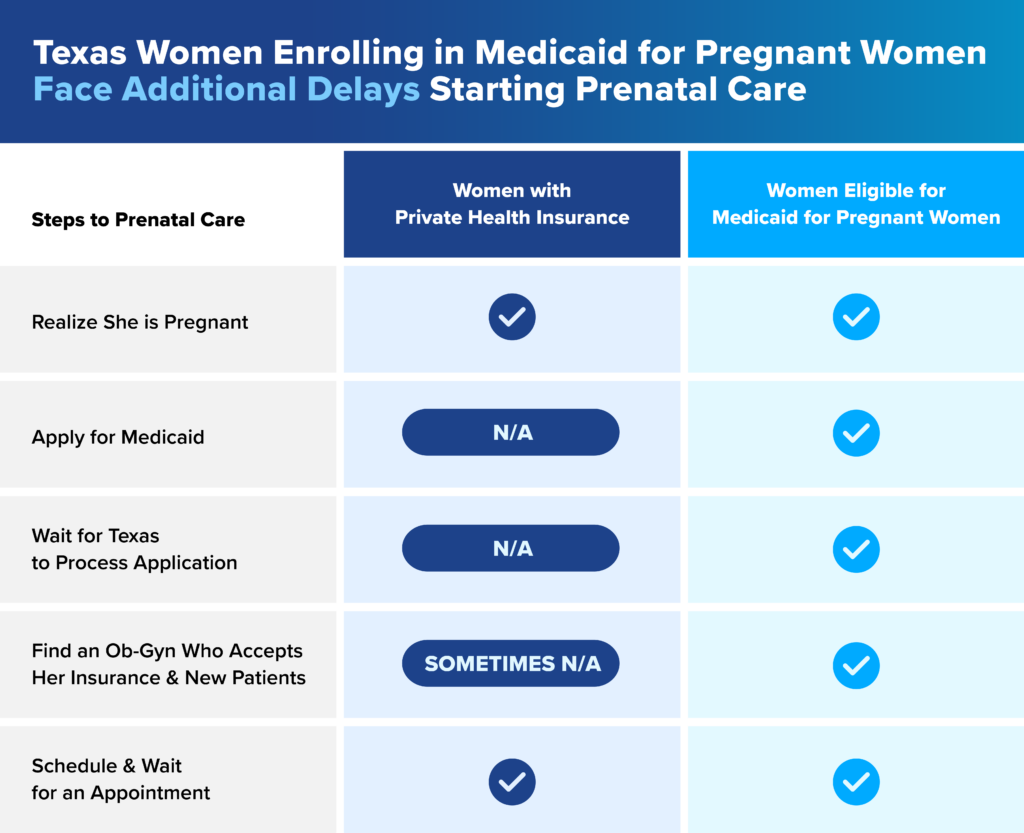
Processing time for Medicaid applications is a key part of this challenge. Federal guidelines allow states up to 45 days to process most Medicaid applications, and the Texas Health and Human Services Commission (HHSC) considers this timeframe acceptable for many applicants. In the context of pregnancy, however, a 45-day delay can mean waiting through most — or all — of the first trimester before coverage begins.
Data we requested from HHSC show that Texas meets the deadline for most applications, even processing 71% of applications within 10 days. However, over the last year, 40,000 pregnant Texas women waited more than a month — and 24,000 waited more than two months — for the state to process their applications for Medicaid health insurance. That delay combined with the other steps in the process make it difficult to start prenatal care in the first trimester.
Pregnant women with Medicaid coverage also face additional challenges finding providers who will accept the low Medicaid reimbursement rates set by the Legislature. In some areas, there are too few providers accepting new patients, and appointment wait times can extend for weeks. In fact, many rural communities in Texas have no local obstetric providers at all — over one-third of counties are considered “maternity care deserts,” meaning patients must travel outside their community to access prenatal care.
A new External Quality Review report on Texas Medicaid confirms that once pregnant women successfully enroll in Medicaid health insurance, they are facing delays getting appointments with doctors. For example, the report shows:
Just over half of callers with low-risk pregnancies were able to get prenatal care appointments that meet the standards set by the state.
18% of the time, callers with high-risk pregnancies were able to get a prenatal care appointment within five days, which is the state standard.
Two of the MCOs had no providers that met the standards for callers with high-risk pregnancies in their third trimester.
For women who remain uninsured throughout their pregnancy, it is even harder to get timely prenatal care.
The Texas Legislature and HHSC Should Take Action
Improving access to early prenatal care will require focused attention from Texas policymakers and state agencies.
There is no single solution — but there are clear opportunities to reduce delays and improve access:
- Streamline Medicaid enrollment processes so eligible pregnant women can be approved more quickly, including strengthening application processing and eligibility systems.
- Strengthen provider networks by improving reimbursement rates and reducing administrative burden, so more providers are able to participate in Medicaid.
- Leverage Medicaid managed care organizations (MCOs) to improve access by strengthening network adequacy standards, reducing wait times for appointments, and ensuring timely scheduling of prenatal visits.
- Reduce administrative and scheduling barriers that delay the first prenatal visit, including through oversight of Medicaid contracts and provider requirements.
- Examine how uninsured women access care prior to pregnancy, including the role of charity care and safety-net providers, and identify opportunities to improve earlier connections to coverage and care.
These issues should be a priority for the next legislative session. In the meantime, state leaders should work to understand the challenges and propose solutions through interim hearings, the Sunset review process, and the development of Legislative Appropriations Requests (LARs) ahead of the next legislative session.
There is a clear opportunity to do so through the Texas House Committee on Public Health interim charge on infant mortality, which directs lawmakers to study infant mortality rates, evaluate evidence-based prevention strategies, and make recommendations to reduce preventable deaths. This includes examining key drivers such as preterm birth and low birthweight, as well as strengthening coordinated prevention efforts related to sudden infant death. Ensuring that access to timely prenatal care is part of this conversation will be critical to improving outcomes for mothers and babies in Texas.
A Practical Opportunity to Improve Outcomes
Ensuring that women can access prenatal care early in pregnancy is one of the most practical and effective steps Texas can take to improve maternal and infant health.
The data are clear: too many women are starting care late, and the consequences can be serious. By addressing the barriers that delay access—especially those related to coverage and provider availability—Texas can help more women begin care earlier, leading to healthier pregnancies, healthier babies, and stronger communities.
Texans Care for Children gratefully acknowledges Methodist Healthcare Ministries of South Texas, Inc., for their financial support of this publication. The opinions expressed in this document are those of Texans Care for Children and do not necessarily reflect the views of Methodist Healthcare Ministries.